Lipid Disorders in Cardiovascular–Kidney–Metabolic Syndrome: What This International Review Adds
Why is this review worth saving — and how can clinicians, educators and researchers use it in practice?
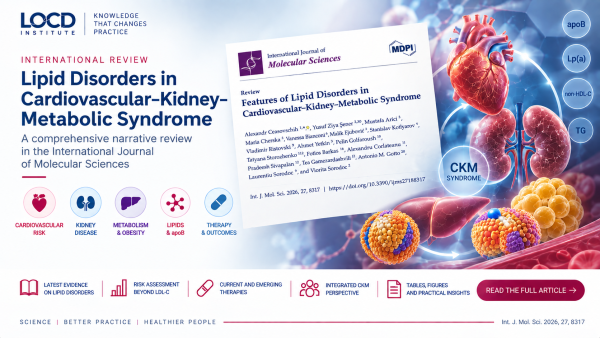
In September 2026, the International Journal of Molecular Sciences published the international review “Features of Lipid Disorders in Cardiovascular–Kidney–Metabolic Syndrome”, focused on lipid abnormalities across the cardiovascular–kidney–metabolic (CKM) continuum.[1]
The review brings together current evidence on dyslipidaemia, obesity, insulin resistance, chronic kidney disease, cardiovascular risk and contemporary therapeutic strategies. It also reflects international scientific collaboration involving Ukrainian researchers and Ukrainian medical institutions.[1]
Read and download the full article on MDPI →
Why this review is worth saving
This is not simply another article about “high cholesterol”. The authors examine lipid-related risk beyond LDL-C and discuss why a standard lipid profile may not fully reflect atherogenic burden in patients with metabolic dysfunction, obesity or chronic kidney disease.[1]
The review may be useful for:
- cardiologists — for a broader understanding of atherogenic and residual cardiovascular risk;
- endocrinologists — for the links between insulin resistance, obesity, MASLD and dyslipidaemia;
- nephrologists — for the characteristic lipid changes associated with chronic kidney disease;
- internists and primary care physicians — for an integrated approach to cardiometabolic risk;
- medical educators — as a source for lectures, presentations and clinical case discussions;
- researchers and PhD candidates — as a structured overview of current evidence and future research directions;
- medical content creators — as a source of references, figures, tables and current terminology.
It is important to note that this publication is a narrative review, not a clinical guideline. The authors used a structured literature search to provide broad coverage of the available evidence, while clinical decisions should continue to rely on current guidelines and individual patient assessment.[1]
What is cardiovascular–kidney–metabolic syndrome?
Cardiovascular–kidney–metabolic syndrome describes the interconnected relationship between metabolic risk factors, chronic kidney disease and the cardiovascular system.
The review highlights several major mechanisms involved in this interaction:
- visceral adiposity;
- insulin resistance;
- chronic systemic inflammation;
- oxidative stress;
- metabolic dysfunction-associated steatotic liver disease (MASLD);
- kidney dysfunction;
- atherogenic dyslipidaemia.
These processes can reinforce one another. Metabolic dysfunction may contribute to cardiovascular and renal injury, while kidney dysfunction can further aggravate abnormalities in lipid metabolism.[1]
LDL-C remains important — but it may not tell the whole story
One of the central themes of the review is the difference between the amount of cholesterol carried within lipoproteins and the number of circulating atherogenic particles.
LDL-C reflects the cholesterol mass within LDL particles, but it does not directly measure the number of atherogenic particles in circulation.[1]
In patients with diabetes, obesity, hypertriglyceridaemia or CKM syndrome, additional markers may help refine cardiovascular risk assessment.
These include:
- apoB — apolipoprotein B;
- non-HDL-C;
- remnant cholesterol;
- Lp(a) — lipoprotein(a);
- triglycerides;
- triglyceride-rich lipoproteins.
ApoB: why particle number matters
Each VLDL, IDL, LDL, remnant and Lp(a) particle contains one molecule of apoB. Plasma apoB can therefore provide an estimate of the total number of circulating atherogenic particles.[1]
The review explains that LDL-C and apoB may be discordant, particularly in metabolically complex patients. In such situations, LDL-C alone may underestimate the total atherogenic particle burden.
At the same time, the authors do not propose replacing LDL-C with apoB in every patient. ApoB is described as a complementary measure, particularly in patients with diabetes, elevated triglycerides or very low achieved LDL-C levels.[1]
Remnant cholesterol and residual cardiovascular risk
Residual cardiovascular risk may persist even when recommended LDL-C targets have been achieved.
One possible contributor is remnant cholesterol — the cholesterol carried in triglyceride-rich lipoprotein remnants. These particles can penetrate the arterial wall and contribute to foam-cell formation and atherosclerotic plaque progression.[1]
This is one reason why assessment of cardiovascular risk cannot always be reduced to LDL-C alone.
Lp(a): a genetically determined component of risk
The review also examines lipoprotein(a), or Lp(a), as an important contributor to residual cardiovascular risk.
Elevated Lp(a) is associated with increased risk of myocardial infarction, ischaemic stroke, aortic valve stenosis and cardiovascular mortality. Its concentration is largely genetically determined.[1]
The authors discuss emerging therapies designed specifically to reduce Lp(a), including antisense oligonucleotides, siRNA-based agents and other investigational approaches.
A clinically important distinction remains: lowering a biomarker is not automatically equivalent to proven improvement in cardiovascular outcomes.[1]
Chronic kidney disease changes the lipid phenotype
Kidney dysfunction significantly influences lipid metabolism.
The review describes several characteristic abnormalities seen in chronic kidney disease:
- elevated triglycerides;
- accumulation of remnant lipoproteins;
- an increased proportion of small dense LDL particles;
- changes in HDL composition and function;
- elevated Lp(a);
- disturbances in apoC-III metabolism.
These changes help explain why lipid assessment in CKD may require a broader approach than interpretation of total cholesterol or LDL-C alone.[1]
Treatment: biomarker reduction versus proven clinical benefit
One of the most clinically useful sections of the review compares lipid-lowering therapies not only by their effect on laboratory values, but also by the strength of evidence supporting reductions in cardiovascular events.
The authors discuss:
- statins;
- ezetimibe;
- bempedoic acid;
- PCSK9 monoclonal antibodies;
- inclisiran;
- fibrates;
- icosapent ethyl;
- apoC-III inhibitors;
- ANGPTL3 inhibitors;
- emerging Lp(a)-lowering therapies.
The review clearly distinguishes therapies supported by cardiovascular outcome data from approaches for which current evidence is based mainly on lipid or biomarker reduction.[1]
Beyond lipids: GLP-1 receptor agonists, SGLT2 inhibitors and weight management
CKM syndrome requires a broader strategy than cholesterol lowering alone.
The article also reviews:
- weight reduction;
- nutrition and physical activity;
- blood pressure control;
- GLP-1 receptor agonists;
- SGLT2 inhibitors;
- renin–angiotensin system inhibition;
- finerenone;
- other cardiorenal protective strategies.
The central idea is an integrated approach to metabolic, cardiovascular and renal risk rather than isolated treatment of individual laboratory abnormalities.[1]
Where can this review be used?
This publication can serve as a practical scientific resource for:
- lectures in lipidology and cardiometabolic medicine;
- presentations on CKM syndrome;
- educational sessions for cardiologists, endocrinologists and nephrologists;
- clinical case discussions involving obesity, diabetes, CKD and dyslipidaemia;
- scientific and narrative review articles;
- PhD and research project development;
- continuing medical education materials;
- literature searches on apoB, Lp(a), remnant cholesterol and CKM.
The tables summarising lipid abnormalities across the CKM continuum and the CKD-specific framing of lipid-lowering therapies may be particularly useful for educational and academic purposes.[1]
Ukraine in international scientific collaboration
The publication also has particular relevance for the Ukrainian medical and scientific community.
Ukrainian researchers and institutions are represented within the international author group.
Mariia Cherska is affiliated with the State Institution “V.P. Komisarenko Institute of Endocrinology and Metabolism of the National Academy of Medical Sciences of Ukraine”, Kyiv.[1]
Tatyana Storozhenko is affiliated with Cardiovascular Center Aalst, Belgium, and the L.T. Malaya Therapy National Institute of the National Academy of Medical Sciences of Ukraine, Kharkiv.[1]
This is a concrete example of Ukrainian clinicians and scientists participating in international academic collaboration and contributing to contemporary medical literature.
Mariia Cherska: expertise in lipidology and cardiology
Mariia Cherska, Doctor of Medical Sciences and cardiologist, works at the intersection of cardiology, lipidology and cardiometabolic medicine.[2]
Her clinical and scientific areas of expertise include dyslipidaemia, cardiovascular prevention, cardiovascular risk management, arterial hypertension, atrial fibrillation, stroke prevention and cardiometabolic disorders.[2]
She is the founder of the Institute of Lipidology, Obesity and Cardiometabolic Diseases (LOCD Institute) and Head of the Consultative and Diagnostic Department at the State Institution “V.P. Komisarenko Institute of Endocrinology and Metabolism of the National Academy of Medical Sciences of Ukraine”.[2]
Her professional work combines clinical cardiology, scientific research and medical education, with a particular focus on evidence-based approaches to lipid disorders and cardiovascular risk reduction.[2]
According to her professional profile, Mariia Cherska is a member of the European Society of Cardiology (ESC), the European Atherosclerosis Society (EAS) and the European Association of Cardiovascular Imaging (EACVI/FEACVI), and serves as an EAS Ambassador.[2]
LOCD is also represented within the EAS Lipid Clinics Network, with Mariia Cherska serving as Head of the EAS Lipid Clinic in Ukraine — an initiative focused on the development of lipidology, identification of familial hypercholesterolaemia and international professional collaboration.[3]
Her participation in the current CKM review is therefore closely aligned with her established clinical and scientific focus on lipidology, cardiovascular prevention and cardiometabolic medicine.
In the Author Contributions section of the publication, Mariia Cherska (M.C.) is credited with “writing — original draft preparation”, documenting her direct contribution to preparation of the manuscript.[1]
View Mariia Cherska’s professional profile →
An important clarification about Ukrainian data
The Ukrainian contribution to this article should be described accurately.
This is a narrative review of international scientific literature, not a separate clinical study based on a Ukrainian patient cohort.
The article’s Data Availability Statement explicitly states that no new data were created or analysed in this study.[1]
The Ukrainian contribution in this publication therefore consists of scientific authorship, expert participation and institutional representation within an international review.
Participation in such collaborations is important because it increases the visibility of Ukrainian medical expertise and strengthens the integration of Ukrainian researchers into international scientific networks.
Key takeaway
Modern lipidology is moving from interpretation of a single cholesterol value toward a more integrated assessment of atherogenic burden.
LDL-C remains a central therapeutic target, while apoB, non-HDL-C, remnant cholesterol, Lp(a), triglycerides, kidney function and the overall metabolic phenotype may provide important additional information in selected patients.
The CKM framework reinforces a simple but important principle: the heart, kidneys, adipose tissue, liver, lipid metabolism and glucose metabolism cannot always be assessed in isolation.
For clinicians, educators and researchers working in cardiology, endocrinology, nephrology, lipidology and preventive medicine, this review provides a useful overview of a rapidly evolving field.
Read the full article on MDPI →
References
[1] Ceasovschih A., Şener Y.Z., Arici M., Cherska M., Bianconi V., Ejubović M., et al.
Features of Lipid Disorders in Cardiovascular–Kidney–Metabolic Syndrome.
International Journal of Molecular Sciences. 2026;27(18):8317.
DOI:
10.3390/ijms27188317
[2] LOCD Institute.
Mariia Cherska — Cardiologist, Doctor of Medical Sciences, specialist in lipidology and cardiometabolic medicine.
[3] LOCD Institute.
LOCD Joins EAS Lipid Clinics Network — Mariia Cherska Appointed Head of EAS Lipid Clinic in Ukraine.
LOCD Joins EAS Lipid Clinics Network — Mariia Cherska Appointed Head of EAS Lipid Clinic in Ukraine
This material is intended for educational and informational purposes and does not replace individual medical advice.