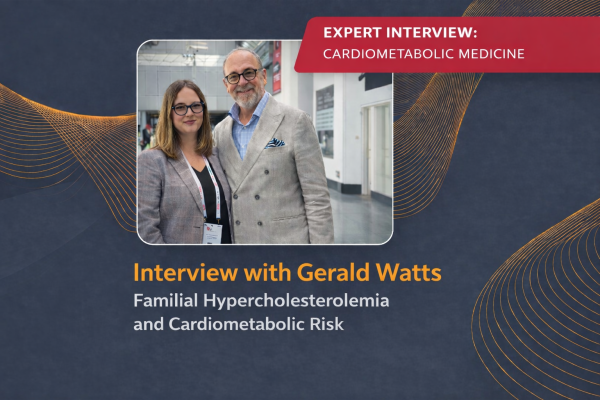
Familial Hypercholesterolemia and Cardiometabolic Medicine:
Insights from Professor Gerald Watts (EAS 2025)
Key clinical perspectives on cascade screening, LDL-C reduction and the evolving paradigm of cardiometabolic medicine.
Context: European Atherosclerosis Society Congress 2025
During the European Atherosclerosis Society (EAS) Congress 2025, leading experts discussed
the future of lipidology, preventive cardiology and genetically driven dyslipidemias.
A central focus was familial hypercholesterolemia (FH) and its role in early atherosclerotic cardiovascular disease.
Who is Professor Gerald Watts?
Professor Gerald Watts is an internationally recognized authority in familial hypercholesterolemia,
clinical lipidology and cardiometabolic medicine. His work integrates clinical care,
translational research and structured screening strategies for patients at very high atherogenic risk.
Familial Hypercholesterolemia: A Critical Clinical Challenge
Familial hypercholesterolemia is a genetic lipid disorder characterized by markedly elevated
LDL cholesterol from early life and significantly increased risk of premature cardiovascular events.
- Persistently high LDL-C levels
- Accelerated atherosclerosis
- Early myocardial infarction risk
- Need for early and intensive therapy
The Underdiagnosis Problem
Despite its clinical significance, the majority of FH patients remain undiagnosed worldwide.
Professor Watts emphasized that cascade screening — systematic testing of relatives —
remains the most effective detection strategy.
Modern LDL-C Lowering Strategies
Contemporary management of FH requires an aggressive and structured lipid-lowering approach.
- High-intensity statins
- Ezetimibe combination therapy
- PCSK9 inhibitors
- Long-acting innovative agents
- Personalized LDL-C targets
Early intervention significantly modifies lifetime cardiovascular risk.
Cardiometabolic Medicine: The New Clinical Paradigm
Cardiometabolic medicine integrates lipidology, endocrinology, preventive cardiology
and genetics into a unified risk-based framework.
This paradigm shifts care from reactive treatment toward proactive risk modification,
focusing on lifetime cardiovascular protection.
Practical Takeaways for Clinicians
- Suspect FH when LDL-C exceeds 190 mg/dL (4.9 mmol/L).
- Always assess detailed family history.
- Implement cascade screening.
- Target maximal safe LDL-C reduction.
- Think in terms of lifetime cardiometabolic risk.
Why This Matters
Structured detection programs, early intervention and integrated cardiometabolic strategies
are essential to reduce the global burden of atherosclerotic cardiovascular disease.
Advance Your Clinical Expertise with LipidTime
LipidTime is an educational platform dedicated to lipidology,
cardiometabolic risk and precision prevention strategies.
- Real-world clinical cases
- Practical treatment algorithms
- ESC / EAS guideline updates
- Neuro-cardiometabolic integration